


CONCORDIA INNOVATION LAB
Thermographic
Livestock Tracking
Thermographic
Livestock Tracking
Harnessing thermal imaging for geographical and physiological livestock monitoring



HOW MIGHT WE?
How might we design a system for quick and accessible livestock tracking for regenerative farmers in the temperate zone?
How might we design a system for quick and accessible livestock tracking for regenerative farmers in the temperate zone?
PROJECT OVERVIEW
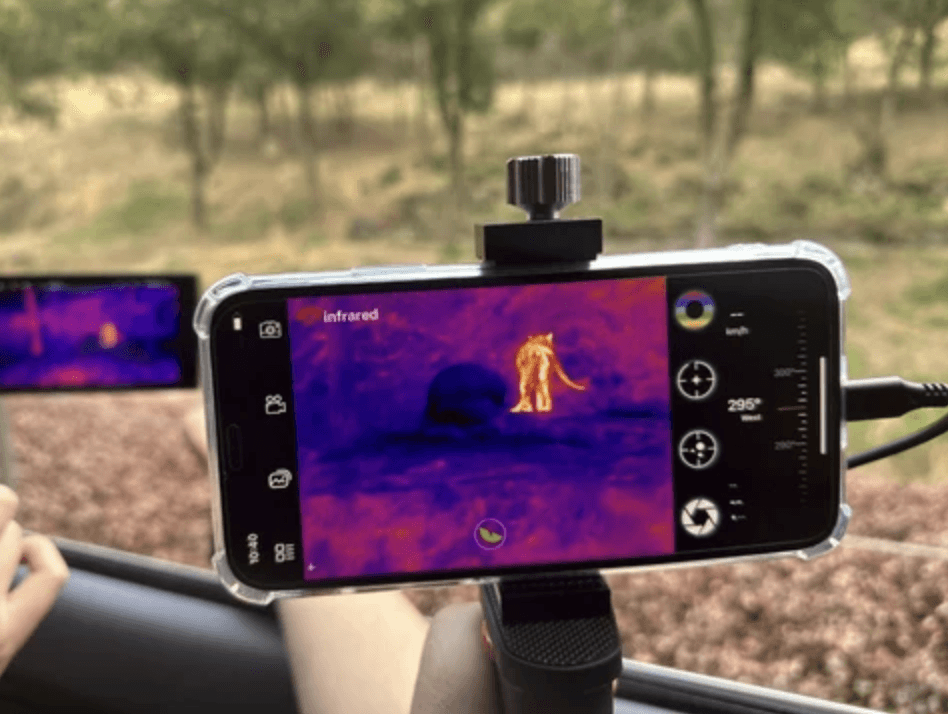
Thermography is an imaging technique that uses infrared wave sensors to capture the temperature of a surface area. For farmers who practice rotational grazing, thermal cameras can be used as a powerful tool for quickly finding animals that have escaped their paddock. The cameras we have listed below have ranges of up to 30+ metres, meaning that animals can be traced from far distances and through thick bush.
Thermography can also be used to help farmers monitor the physiological state of their animals using a non-invasive, low-cost and low-labour device. In regenerative farming, this technology enables early intervention, helping farmers address health issues promptly and reducing reliance on antibiotics.
Thermography is an imaging technique that uses infrared wave sensors to capture the temperature of a surface area. For farmers who practice rotational grazing, thermal cameras can be used as a powerful tool for quickly finding animals that have escaped their paddock. The cameras we have listed below have ranges of up to 30+ metres, meaning that animals can be traced from far distances and through thick bush.
Thermography can also be used to help farmers monitor the physiological state of their animals using a non-invasive, low-cost and low-labour device. In regenerative farming, this technology enables early intervention, helping farmers address health issues promptly and reducing reliance on antibiotics.
Status
Ongoing Field Tests
TEAM
Maya Marshall, Parsa Fard
Stack
Livestock Tracking, Farm Security
START date
Fall 2025
Two Use Cases
Two Use Cases
We discovered two areas where thermal imaging can be used to increase efficiency in regenerative farming.
1. Location Tracking
Thermal cameras are a common tool amongst hunters and wildlife observers to identify animals at night, from long distances, and through trees and grass. For farmers practicing rotational grazing, losing even a single calf is a major financial loss. As thermographic technology becomes more accessible, regenerative farmers can use this tool to quickly find animals that are hiding in thick bush and have escaped.

2. Physiological Monitoring
Over 50 clinical studies demonstrate that thermography can be effectively used to detect various diseases, viruses and injuries in livestock animals. Many of these studies find that more clinical research needs to be done to ground the accuracy of medical diagnosis through thermography. Thermographic scans through the devices mentioned below should not be used as a method of clinical diagnosis but rather as a way to gain general insight on the animal's physiological state.
Key Criteria
we identified three key features that our thermal camera must possess to be useful for our use case.
Long Range
The camera needed to be able to detect past a range of 500m. This ruled out many short-range cameras that are used for construction and electrical work.
High Resolution
The camera needed to be able to identify animals accurately, and through a lot of grass. We decided on a resolution of 384 x 288, which ended up being a mid-range camera.
Affordable
We decided on a price range of under $1500 for our camera, which is a pretty low so we had to do some in-depth research and keep looking for deals.
Cattle Injury
Case Study
Right posterior foot

Right anterior foot
At Kirkview Farms (Glengarry, ON) we encountered a cow that displayed health issues in its back hooves. Thermal scans were able to visualize that the cow was placing its weight on the right anterior foot (shown below), meaning that the other anterior foot was likely infected and causing pain.
The scans for this case study were taken using the TOPDON TC002C Camera and included the following steps.
Attach the thermal camera to the iphone.
Open “TopInfrared” Application
Set ambient temperature
Set Surface Emissivity (0.95)
Set distance to subject (0.5-1m)
Key Criteria
We identified three key features that our thermal camera must possess to be useful for our use case.
Long Range
Long Range
The camera needed to be able to detect past a range of 500m. This ruled out many short-range cameras that are used for construction and electrical work.
The camera needed to be able to detect past a range of 500m. This ruled out many short-range cameras that are used for construction and electrical work.
High Resolution
High Resolution
The camera needed to be able to identify animals accurately, and through a lot of grass. We decided on a resolution of 384 x 288, which ended up being a mid-range camera.
The camera needed to be able to identify animals accurately, and through a lot of grass. We decided on a resolution of 384 x 288, which ended up being a mid-range camera.
Affordable
Affordable
We decided on a price range of under $1500 for our camera, which is a pretty low so we had to do some in-depth research and keep looking for deals.
Camera Analysis
The following table compares several thermal cameras that are currently on the market (2025) and fit our criteria.
Model
Tapo C460
(MagCam
4K)
Tapo C465
(4K with built
-in solar)
Tapo C560WS
(VistaCam
360 / 4K PTZ)
Tapo C425
(MagCam 2K)
Tapo C410
(MagCam
2K / smaller)Â
Tapo C615F
(2K Floodlight
PTZ solar kit)Â
Tapo H500
(HomeBase hub
for storage)Â
Type
Battery / solar
kit option
Battery with
integrated
solar panel
Wired or Wi-Fi
(expects mains)
Battery /
solar kit option
Battery / s
olar kit option
Solar floodlight
PTZ
N/A (hub)
Resolution
4K (8MP).
Edge
sharpening
4K (8MP)
4K (8MP)
2K (QHD)
2K (QHD)
2K (QHD)
(floodlight
model)
N/A
Power / Solar
Battery +
optional solar
panel
Built-in solar +
battery
(all-in-one)
Corded mains
preferred
(some packs
with solar
options)
Battery +
solar KIT available
Battery +
solar KIT available
Solar kit with
floodlight +
battery
(kit available)
N/A
PTZ (pan/
tilt/zoom)
No (fixed)
No (fixed)
Yes - 360°
pan / 70° tilt
(PTZ)
No (fixed)
No (fixed)
Yes — 360°
pan / tilt
(floodlight PTZ)
N/A
Zoom
Digital zoom
(4K helps
crop)
Digital zoom /
crop
Up to 18×
digital zoom
(store listing)
Digital zoom
(2K less crop
detail than 4K)
Digital zoom
Digital zoom
N/A
Weather
rating
IP66
IP66
Outdoor
(robust IP
rating
indicated)
IP66
IP65/66
(outdoor
capable)
Outdoor /
floodlight
integrated
Indoor hub
AI / Pet
detection
Yes
(person/
vehicle
/pet)
Enhanced
AI/powered
detection
advertised
AI tracking /
person/pet
detection
Yes -person/
vehicle/pet
AI included
Smart person
detection
AI detection
advertised
Enables local
storage, central
management &
no-monthly local
recording
Storage
microSD
/ cloud
microSD
/ cloud
microSD /
HomeBase
/ cloud
microSD
/ cloud
microSD
/ cloud
microSD
/ cloud
microSD
/ cloud
Built-in 16GB
eMMC +
expandable
2.5â€
SATA
HDD/SSD
Official price
(TP-Link
store,
USD)
Single:
$129.99 ;
2-pack Solar kit:
$209.98
Price varies by
region- product
page lists features
(official TP-Link
product page).
Wired single
(store listing):
$99.99 (variant);
2-pack sales shown
at $169.99 (2-pack) -
see product
variants.Â
C425 Kit (store):
shown $105.99
(sale price on TP-
Link store).Â
Price varies by
region; product
& kit listed on
official site
(store variants
show promotional
pricing sometimes).
Â
C615F Kit
(store example):
shown $84.99-
$99.99 (launch/
discount prices
; varies by
bundle).Â
Store price shown:
$129.99 (sale
/ US store price)
.Â
Best For/
quick note
Remote/off-grid
4K where you can
rely on solar.
Good balance of
high resolution
+ wire-free
install.
Best where you
want fully integrated
solar + 4K without
separate solar panel.
Expect tradeoffs
in battery sizing vs
continuous
4K recording.
Best PTZ for
sweeping
pastures/driveways
and zooming in for
ID. Use where you
can supply power
(PTZ uses more
power).
Good low-power,
long battery life
option for many
remote spots.
Lower data/storage
needs than 4K.
Budget solar
camera for
coops/feeders
where 2K is enough
and power life
matters.
Great where you
want lighting + PTZ
+ solar (driveway/
barn entrance).
Lower resolution
than 4K but
floodlight
improves night ID.
Strongly
recommended
if you deploy several
4K cams — offloads
cloud fees & reduces
per-camera microSD
reliance.
Cattle Injury Case Study
Right posterior foot
Nov 8,2024
Right anterior foot
Nov 8,2024
At Kirkview Farms (Glengarry, ON) we encountered a cow that displayed health issues in its back hooves. Thermal scans were able to visualize that the cow was placing its weight on the right anterior foot (shown below), meaning that the other anterior foot was likely infected and causing pain.
The scans for this case study were taken using the TOPDON TC002C Camera and included the following steps.
Attach the thermal camera to the iphone.
Open “TopInfrared” Application
Set ambient temperature
Set Surface Emissivity (0.95)
Set distance to subject (0.5-1m)


Presented at Concordia 4TH SPACE
Presented at Concordia 4TH SPACE
The project culminated in a public presentation at 4TH SPACE, where the proposed solution was demonstrated to concordia students, faculty members and the wider community.
The project culminated in a public presentation at 4TH SPACE, where the proposed solution was demonstrated to concordia students, faculty members and the wider community.
Concordia 4TH SPACE presentation recording
Interested in learning more or collaborating?
Contact us
agripulse.info@gmail.com
Interested in learning more or collaborating?
Contact us
agripulse.info@gmail.com
Interested in learning more or collaborating?
Contact us
agripulse.info@gmail.com